M233S04ES4R8.mws
- 1. A line that is perpendicular to the plane 4*x+3*y+2*z=13 has symmetric equations
(4*x+1)/a = (3*y-2)/b ` `=4*z
What is a?
a) 1 b) 2 c) 3 d) 4 e) 5
f) 6 g) 7 h) 8 i) 9 j) 10
- 2. If `<`*14 , -2*`>`=`<`*a,b*`>`+`<`*c,d*`>` where `<`*a,b*`>` is parallel to `<`*3,1*`>` and `<`*c,d*`>` is perpendicular
to `<`*3,1*`>`, then what is b?
a) 1 b) 2 c) 3 d) 4 e) 5
f) 6 g) 7 h) 8 i) 9 j) 10
- 3. A curve is parameterized by r(t)=`<`*t,t^3/3,t^2*`>` . Calculate its principal unit normal vector
N=`<`*a,b,c*`>` at the point (1, 1/3, 1). What is a?
a) 1/3 b) -1/3 c) 1/sqrt(2) d) -1/sqrt(2) e) 1/sqrt(3)
f) -1/sqrt(3) g) 1/sqrt(6) h) -1/sqrt(6) i) 2/sqrt(6) j) -2/sqrt(6)
- 4. Suppose that x^2 +y*z-z^3=2*x*z-9 . Calculate diff( z ,x) at ``(3,1,2).
a) 3/8 b) 4/15 c) 2/9 d) 3/7 e) 5/13
f) 2/17 g) 2/11 h) 3/19 i) 4/17 j) 8/21
- 5. The function f(x,y)=3*x^2*y- x*y^2- 9*x*y has exactly one critical point P = (a,b) that does not lie on a coordinate axis. Choose the ordered list [b,what] where b is the y-coordinate of the critical point P = (a,b) and "what" describes the behavior of f at P.
a) [-1,local minimum] b) [-2,local minimum] c) [-3,local minimum]
d) [-1,local maximum] e) [-2,local maximum] f) [-3,local maximum]
g) [-1,saddle point] h) [-2,saddle point] i) [-3,saddle point]
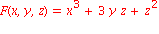
- 6. Let u be the upward unit normal of the plane x-2*y+2*z=7. Calculate the directional derivative of F(x,y,z) = x^3+3*y*z+z^2 in the direction of u at the point ( 2, 2, 3).
a) 1 b) 2 c) 3 d) 4 e) 5
f) 6 g) 7 h) 8 i) 9 j) 10
- 7. Let ( a , b ) be the point in the first quadrant at which f(x,y)=x*y+1 has a maximum value subject to the constraint x^2+2*y^2=1. Calculate a and b. What is the value of a^2+b^2 ?
a) 1/8 b) 1/4 c) 3/8 d) 1/2 e) 5/8
f) 3/4 g) 7/8 h) 3/16 i) 5/16 j) 7/16
- 8. Calculate the integral of x+2*y over the region in the first quadrant that is bounded by the coordinate axes and the circle x^2+y^2=4 .
a) 1 b) 2 c) 3 d) 4 e) 5
f) 6 g) 7 h) 8 i) 9 j) 10
- 9. The vector `<`*a,-3,-1*`>` is tangent to the surface x^2+2*y^3-3*z^2=3 at the point (2,1,1). What is a ?
a) 1 b) 2 c) 3 d) 4 e) 5
f) 6 g) 7 h) 8 i) 9 j) 10
- 10. Calculate
where U is the solid half-ball that is described by the inequalities x^2+y^2+z^2<=1 and z>=0.
a) 0 b) Pi/12 c) Pi/8 d) Pi/6 e) Pi/4
f) Pi/3 g) Pi/2 h) Pi i) 2*Pi j) 3*Pi
- 11. Calculate int( y*dx+2*x*dy+(z-x*y+3),z=C..``). where C is the oriented curve parameterized by r(t)=[3*t,t^2,t^3], 0 <=t ``<=1 .
a) 1 b) 2 c) 3 d) 4 e) 5
f) 6 g) 7 h) 8 i) 9 j) 10
- 12. The vector field
is the gradient field of some function f(x,y). Calculate f(2,1) - f(0,1).
a) 2 b) 4 c) 6 d) 8 e) 10
f) 12 g) 14 h) 16 i) 18 j) Cannot be calculated from given information.
- 13. Calculate int( (y+z)*dx+(x+1)*dy+(2*z+x),z=C..``) where C is the oriented curve parameterized by r(t)=[sqrt(t),cos(Pi*sqrt(t)),t*ln(t^2-t+1)], 0 <=t ``<=1 .
a) 1 b) -1 c) 2 d) -2 e) 3
f) -3 g) 4 h) -4 i) 5 j) -5
- 14. What is the surface area of the part of z=1+x^2/2+y^2/2 that lies over the unit disk x^2+y^2<=1 ?
a) sqrt(2)/3*Pi b) (sqrt(2)-1)/3*Pi c) (2-sqrt(2))/3*Pi d) 4*sqrt(2)/3*Pi e) 2*(2*sqrt(2)-1)*Pi/3
f) (4*(sqrt(2)-1))/3*Pi g) 2*(4-sqrt(2))/3*Pi h) (4-sqrt(2))*Pi/3 i) 2*(2-sqrt(2) )*Pi/3 j) 4*(2*sqrt(2)-1)*Pi/3
- 15. Calculate Int(-5*y*dx+11*x,y=C..``) where C is the unit circle traversed counter-clockwise.
a) 0 b) Pi c) 2*Pi d) 3*Pi e) 4*Pi
f) 6*Pi g) 8*Pi h) 12*Pi i) 16*Pi j) 18*Pi
- 16. Let G be a solid region in space. Suppose that the boundary S of G is an orientable closed surface with outward unit normal n. Vector calculus tells us that
for some function f.
If
then what is f ( 0 , 1 , 2 ) ?
a) 0 b) 1 c) 2 d) 3 e) 4
f) 5 g) 6 h) 7 i) 8 j) 9
- 17. Suppose that f(x,y,z)=3*x^2 - 2*y^2 + 3*z^3 . Calculate div(grad(f(x,y,z)) at the point (3,2,1).
a) 1 b) 2 c) 3 d) 4 e) 5
f) 8 g) 12 h) 15 i) 16 j) 20
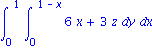
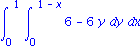
- 18. Calculate the surface integral of f(x,y,z)=2*x+z over that part of the plane 2*x+2*y+z=2
that lies in the first octant.
a) 1 b) 2 c) 3 d) 4 e) 5
f) 6 g) 7 h) 8 i) 9 j) 10
- 19. Let U be the cube with equal sides of length one and vertices at ( 0, 0, 0 ) and ( 1, 1, 1 ). Let S be the surface of that part of the cube that lies above the xy plane. (In other words, S has the shape of a box without its bottom.) Let n denote the outward-pointing unit normal on S . Calculate
(also denoted by
as in our text) where
a) 1 b) -1 c) 2 d) -2 e) 3
f) -3 g) 4 h) -4 i) 5 j) -5
- 20. Let U be the cube with equal sides of length one and vertices at ( 0, 0, 0 ) and ( 1, 1, 1 ) (as in the preceding problem). In this problem, let S be the entire surface of the cube.
a) 1 b) -1 c) 2 d) -2 e) 3
f) -3 g) 4 h) -4 i) 5 j) -5
Math 233 Spring 2004 Final Exam
1. A line that is perpendicular to the plane  has symmetric equations


What is a?
a) 1 b) 2 c) 3 d) 4 e) 5
f) 6 g) 7 h) 8 i) 9 j) 10
Solution: (b)
2. If  where
where  is parallel to
  and
and  is perpendicular
to  , then what is b?
a) 1 b) 2 c) 3 d) 4 e) 5
f) 6 g) 7 h) 8 i) 9 j) 10
Solution: (d)
3. A curve is parameterized by 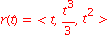 . Calculate its principal unit normal vector
 at the point (1, 1/3, 1). What is
  ?
?
a)  b)
b)  c)
c)  d)
d)  e)
e) 
f)  g)
g)  h)
h)  i)
i)  j)
j) 
Solution: (d)
4. Suppose that 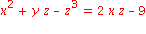 . Calculate
  at
at  .
.
a) 3/8 b) 4/15 c) 2/9 d) 3/7 e) 5/13
f) 2/17 g) 2/11 h) 3/19 i) 4/17 j) 8/21
Solution: (f)
| > |
eqn := x^2 +y*z-z^3=2*x*z-9; |

| > |
F := (x,y,z) -> lhs(eqn)-rhs(eqn); |

| > |
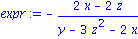
expr := - diff(F(x,y,z),x)/diff(F(x,y,z),z); |
| > |
subs({x=3,y=1,z=2},expr); |

5. The function  has exactly one critical point P = (a,b) that does not lie on a coordinate axis. Choose the ordered list [b,what] where b is the y-coordinate of the critical point P = (a,b) and "what" describes the behavior of
  at P.
at P.
a) [-1,local minimum] b) [-2,local minimum] c) [-3,local minimum]
d) [-1,local maximum] e) [-2,local maximum] f) [-3,local maximum]
g) [-1,saddle point] h) [-2,saddle point] i) [-3,saddle point]
Solution: (f)
| > |
f := (x,y) -> 3*x^2*y - x*y^2- 9*x*y; |

| > |
solve({diff(f(x,y),x) = 0 , diff(f(x,y),y) = 0}, {x,y} ); |

| > |
diff(f(x,y),x$2)*diff(f(x,y),y$2)-(diff(f(x,y),x,y))^2; |


| > |
subs({x=1,y=-3},diff(f(x,y),x$2)); |

| > |
f(1,-3); f(.99,-3.1); f(.99,-2.9); |


6. Let  be the upward unit normal of the plane
  . Calculate the directional derivative of
  in the direction of
  at the point ( 2, 2, 3).
a) 1 b) 2 c) 3 d) 4 e) 5
f) 6 g) 7 h) 8 i) 9 j) 10
Solution: (f)
Warning, new definition for norm
Warning, new definition for trace
| > |
F := (x,y,z) -> x^3+3*y*z+z^2; |

| > |
u := [1/3,-2/3,2/3]; v := grad(F(x,y,z),[x,y,z]); |
![u := [1/3, (-2)/3, 2/3]](images/final-sp2004_44.gif)
![v := VECTOR([3*x^2, 3*z, 3*y+2*z])](images/final-sp2004_45.gif)
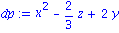
| > |
subs({x=2,y=2,z=3}, dp ); |

7. Let ( a , b ) be the point in the first quadrant at which 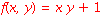 has a maximum value subject to the constraint
  . Calculate a and b. What is the value of
  ?
?
a)  b)
b)  c)
c)  d)
d)  e)
e) 
f)  g)
g)  h)
h)  i)
i)  j)
j) 
Solution: (f)
| > |
f := (x,y) -> x*y+1: phi := (x,y) -> x^2 + 2*y^2: |
| > |
eqn1 := diff(f(x,y),x) = lambda*diff(phi(x,y),x); |

| > |
eqn2 := diff(f(x,y),y) = lambda*diff(phi(x,y),y); |


| > |
solve( {eqn1,eqn2,eqn3}, {x,y,lambda}); |

| > |
levelCurve[1] := implicitplot( f(x,y)=f(c,1/2), x = -3/2..3/2,y=-3/2..3/2,color=pink,thickness=2): |
| > |
levelCurve[2] := implicitplot( x^2+2*y^2=1, x = -3/2..3/2,y=-3/2..3/2,color=plum,thickness=2): |
| > |
levelCurve[3] := contourplot(f(x,y), x = -3/2.. 3/2, y= -3/2..3/2, contours=10,color=COLOR(RGB,0.75,0.7,0.7)): |
| > |
display(seq(levelCurve[j],j=1..3)); |
![[Plot]](images/final-sp2004_65.gif)
8. Calculate the integral of  over the region in the first quadrant that is bounded by the coordinate axes and the circle
  .
.
a) 1 b) 2 c) 3 d) 4 e) 5
f) 6 g) 7 h) 8 i) 9 j) 10
Solution: (h)
| > |
int(int( (r*cos(t)+2*r*sin(t))*r,r=0..2),t=0..Pi/2); |

9. The vector  is tangent to the surface
 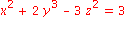 at the point (2,1,1). What is a ?
a) 1 b) 2 c) 3 d) 4 e) 5
f) 6 g) 7 h) 8 i) 9 j) 10
Solution: (c)
| > |
F := (x,y,z) -> x^2+2*y^3-3*z^2; |

| > |
grad(F(x,y,z),[x,y,z]); |
![VECTOR([2*x, 6*y^2, -6*z])](images/final-sp2004_72.gif)
| > |
v := subs({x=2,y=1,z=1}, " ); #Normal to surface |
![v := VECTOR([4, 6, -6])](images/final-sp2004_73.gif)
| > |
solve(dotprod(v,[a,-3,-1])=0,a);
#Tangent vector is perpendicular to Normal vector |

10. Calculate
![[Inserted Image]](images/final-sp2004_75.gif)
where U is the solid half-ball that is described by the inequalities  and
and  .
.
a)  b)
b)  c)
c)  d)
d)  e)
e) 
f)  g)
g)  h)
h)  i)
i)  j)
j) 
Solution: (e)
| > |
int(int(int(rho*cos(phi)*rho^2*sin(phi),rho=0..1),phi=0..Pi/2),theta=0..2*Pi); |

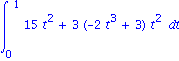
11. Calculate 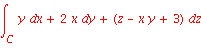 . where C is the oriented curve parameterized by
 ![r(t) = [3*t, t^2, t^3]](images/final-sp2004_90.gif) ,
, 
 .
.
a) 1 b) 2 c) 3 d) 4 e) 5
f) 6 g) 7 h) 8 i) 9 j) 10
Solution: (g)
| > |
r := t -> [3*t,t^2,t^3]; |
![r := proc (t) options operator, arrow; [3*t, t^2, t^3] end proc](images/final-sp2004_93.gif)
| > |
Int( r(t)[2]*diff(r(t)[1],t)+ 2*r(t)[1]*diff(r(t)[2],t)+(r(t)[3]-r(t)[1]*r(t)[2]+3)*diff(r(t)[3],t),t=0..1); |

12. The vector field
![[Inserted Image]](images/final-sp2004_96.gif)
is the gradient field of some function f(x,y). Calculate f(2,1) - f(0,1).
a) 2 b) 4 c) 6 d) 8 e) 10
f) 12 g) 14 h) 16 i) 18 j) Cannot be calculated from given information.
Solution: (h)
Warning, new definition for norm
Warning, new definition for trace
| > |
F := vector([y^2+7,2*x*y+3*y^2]); |
![F := VECTOR([y^2+7, 2*x*y+3*y^2])](images/final-sp2004_97.gif)
| > |
curl(vector([y^2+7,2*x*y+3*y^2,0]),[x,y,z]); #F is conservative |
![VECTOR([0, 0, 0])](images/final-sp2004_98.gif)
| > |
eqn := u(x,y) = int(y^2+7,x) + g(y); |



| > |
diff(g(y),y) = solve(",diff(g(y),y)); |

| > |
eqn2 := subs(g(y)=y^3+C,eqn); |

| > |
subs( {x=2,y=1}, rhs(eqn2)) - subs({x=0,y=1}, rhs(eqn2)); |

13. Calculate 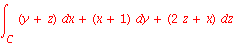 where C is the oriented curve parameterized by
 ![r(t) = [sqrt(t), cos(Pi*sqrt(t)), t*ln(t^2-t+1)]](images/final-sp2004_106.gif) ,
, 
 .
.
a) 1 b) -1 c) 2 d) -2 e) 3
f) -3 g) 4 h) -4 i) 5 j) -5
Solution: (f)
| > |
r := (t) -> [sqrt(t), cos(Pi*sqrt(t)),t*ln(t^2-t+1)]; |
![r := proc (t) options operator, arrow; [sqrt(t), cos(Pi*sqrt(t)), t*ln(t^2-t+1)] end proc](images/final-sp2004_109.gif)
![P := [0, 1, 0]](images/final-sp2004_110.gif)
![Q := [1, -1, 0]](images/final-sp2004_111.gif)
| > |
F := vector([y+z,x+1,2*z+x]); |
![F := VECTOR([y+z, x+1, 2*z+x])](images/final-sp2004_112.gif)
| > |
curl(F,[x,y,z]); #F is conservative |
![VECTOR([0, 0, 0])](images/final-sp2004_113.gif)
| > |
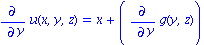
eqn := u(x,y,z) = int(y+z,x) + g(y,z); |

| > |
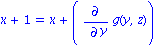
diff(g(y,z),y) = solve(",diff(g(y,z),y)); |

| > |
eqn2 := subs(g(y,z)=y+h(z),eqn); |

| > |
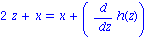
2*z+x = diff(rhs(eqn2),z); |
| > |
diff(h(z),z) = solve( " , diff(h(z),z)); |

| > |
eqn3 := subs(h(z)=z^2 + C, eqn2); |

| > |
evalm( grad(rhs(eqn3),[x,y,z]) - F ); #Check |
![VECTOR([0, 0, 0])](images/final-sp2004_122.gif)
| > |
subs( {x=1,y=-1,z=0}, rhs(eqn3)) - subs({x=0,y=1,z=0}, rhs(eqn3)); |

14. What is the surface area of the part of 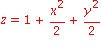 that lies over the unit disk
  ?
?
a)  b)
b)  c)
c)  d)
d)  e)
e) 
f)  g)
g)  h)
h)  i)
i)  j)
j) 
Solution: (e)
| > |
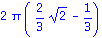
2*Pi*int(r*(1+r^2)^(1/2),r=0..1); |
| > |
answers := [sqrt(2)/3*Pi,(sqrt(2)-1)/3*Pi,(2-sqrt(2))/3*Pi,4*sqrt(2)/3*Pi,2*(2*sqrt(2)-1)*Pi/3,(4*(sqrt(2)-1))/3*Pi,2*(4-sqrt(2))/3*Pi,(4-sqrt(2))*Pi/3,2*(2-sqrt(2) )*Pi/3,4*(2*sqrt(2)-1)*Pi/3]: |
| > |
for i from 1 to 9 do
for j from i+1 to 10 do
if (answers[i]=answers[j]) then print(`repeat`);
fi;
od;
od; |
| > |
int(int(sqrt(1+r^2)*r,r=0..1),t=0..2*Pi); |

| > |
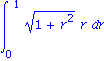
int(r*sqrt(1+r^2),r=0..1); |
| > |
evalf(Int(r*sqrt(1+r^2),r=0..1)); |

| > |
testeq(diff((1+r^2)^(3/2)/3,r) = sqrt(1+r^2)*r); |

| > |
subs(r=1,(1+r^2)^(3/2)/3) - subs(r=0,(1+r^2)^(3/2)/3); |


15. Calculate 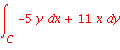 where C is the unit circle traversed counter-clockwise.
a)  b)
b)  c)
c)  d)
d)  e)
e) 
f)  g)
g)  h)
h)  i)
i)  j)
j) 
Solution: (i)
| > |
r := t -> [cos(t),sin(t)]: |
| > |
Int( -5*r(t)[2]*diff(r(t)[1],t) + 11*r(t)[1]*diff(r(t)[2],t),t=0..2*Pi); |
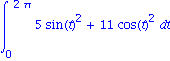

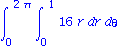
More easily by Green's Theorem:
| > |
Int(Int( r*(diff(11*x,x)-diff(-5*y,y)),r=0..1),theta=0..2*Pi); |

16. Let G be a solid region in space. Suppose that the boundary S of G is an orientable closed surface with outward unit normal n. Vector calculus tells us that
![[Inserted Image]](images/final-sp2004_158.gif)
for some function f.
![[Inserted Image]](images/final-sp2004_159.gif)
If
![[Inserted Image]](images/final-sp2004_160.gif)
then what is f ( 0 , 1 , 2 ) ?
a) 0 b) 1 c) 2 d) 3 e) 4
f) 5 g) 6 h) 7 i) 8 j) 9
Solution: (e)
| > |
diverge([x*y,2*y*z,x^2+x^2*y^3-y*z],[x,y,z]); |


17. Suppose that  . Calculate div(grad(f(x,y,z)) at the point (3,2,1).
a) 1 b) 2 c) 3 d) 4 e) 5
f) 8 g) 12 h) 15 i) 16 j) 20
Solution: (j)
| > |
f := (x,y,z) -> 3*x^2 - 2*y^2 + 3*z^3; |

| > |
grad(f(x,y,z),[x,y,z]); |
![VECTOR([6*x, -4*y, 9*z^2])](images/final-sp2004_165.gif)

18. Calculate the surface integral of 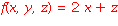 over that part of the plane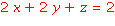
that lies in the first octant.
a) 1 b) 2 c) 3 d) 4 e) 5
f) 6 g) 7 h) 8 i) 9 j) 10
Solution: (b)
| > |
vectorLength := v -> sqrt(sum(v[i]^2,i=1..vectdim(v))); |
![vectorLength := proc (v) options operator, arrow; sqrt(sum(v[i]^2, i = 1 .. vectdim(v))) end proc](images/final-sp2004_169.gif)
| > |
r := (x,y) -> vector([x,y,1-2*(x+y)]); #surface parameterization |
![r := proc (x, y) options operator, arrow; vector([x, y, 1-2*x-2*y]) end proc](images/final-sp2004_170.gif)
| > |
rx := map(z->diff(z,x),r(x,y)); |
![rx := VECTOR([1, 0, -2])](images/final-sp2004_171.gif)
| > |
ry := map(z->diff(z,y),r(x,y)); |
![ry := VECTOR([0, 1, -2])](images/final-sp2004_172.gif)
![VECTOR([2, 2, 1])](images/final-sp2004_173.gif)
| > |
surfaceAreaFactor := vectorLength("); |

| > |
f := (x,y,z) -> 2*x + z; |

| > |
Int(Int(f(x,y,z)*surfaceAreaFactor,y=0..1-x),x=0..1); |

19. Let U be the cube with equal sides of length one and vertices at ( 0, 0, 0 ) and ( 1, 1, 1 ). Let S be the surface of that part of the cube that lies above the  plane. (In other words, S has the shape of a box without its bottom.) Let n denote the outward-pointing unit normal on S . Calculate
![[Inserted Image]](images/final-sp2004_180.gif)
(also denoted by
![[Inserted Image]](images/final-sp2004_181.gif)
as in our text) where
![[Inserted Image]](images/final-sp2004_182.gif)
a) 1 b) -1 c) 2 d) -2 e) 3
f) -3 g) 4 h) -4 i) 5 j) -5
Solution: (a)
Using Stokes's Theorem the required surface integral can be calculated by the line integral

integrated counterclockwise over the boundary of the square in the xy plane. Since z = dz = 0 on all four sides and dy = 0 on the two sides parallel to the x-axis we have

20. Let U be the cube with equal sides of length one and vertices at ( 0, 0, 0 ) and ( 1, 1, 1 ) (as in the preceding problem). In this problem, let S be the entire surface of the cube.
![[Inserted Image]](images/final-sp2004_185.gif)
a) 1 b) -1 c) 2 d) -2 e) 3
f) -3 g) 4 h) -4 i) 5 j) -5
Solution: (f)
Using the Divergence Theorem
| > |
F := vector([y*z^5,12*z^3*y,y^3]); |
![F := VECTOR([y*z^5, 12*z^3*y, y^3])](images/final-sp2004_186.gif)
| > |
p := diverge(F,[x,y,z]); |

| > |
int(int(int(p,z=0..1),y=0..1),x=0..1); |
