M233F02ES4R8.mws
- 1. If u and v are vectors and u=lambda*v for some scalar lambda then which of the following must be true?
- 2. If the vectors `<`*(-3),b,b*`>` and `<`*2,1,2*b*`>` are perpendicular then what might b be?
- 3. The line through the points ( 3, -1, 2) and (5, 2, -1) passes through a point (a, b, -4). What is b ?
a) -4 b) -3 c) -2 d) -1 e) 0
- 4. A plane passes through the three points (1, 0, 0), (0, 2, 0), and (2, 3, 3).
- 5. The function f(x,y)=2*x^2*y-3*x*y^2-6*x*y has one critical point P = (a,b) with ab < 0. Choose the ordered list [a,what] where a is the abscissa of the critical point P = (a,b) and "what" describes the behavior of f at P.
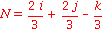
- 6. At an instant of time a particle's acceleration is `<`*2,1,-3*`>` and its principal unit normal is
N=2/3*i+2/3*j-k/3. What is its normal component of acceleration a[N]?
- 7. The maximum value of f(x,y)=x+2*y on the unit circle x^2+y^2=1
occurs at (a,b). What is the value of a ?
- 8. If x^2 +y^3-z^4=2*x*y*z+4 then calculate diff( z ,x) at ``(3,2,1).
- 9. The vector `<`*a,1,-1*`>` is tangent to the surface x^2+2*y^3-3*z^2=3 at the point (2,1,1). What is a ?
- 10. Calculate int( y*dx+2*x*dy+(z-x*y+3),z=C..``). where C is the oriented curve parameterized by r(t)=[t,t^2,t^3], t=0..1.
- 11. The vector field
- 12. Calculate int( (y+z)*dx+(x+1)*dy+(2*z+x),z=C..``) where C is the oriented curve parameterized by r(t)=[sqrt(t),sin(Pi/2*t^2),t*exp(t-1)], t=0..1.
a) 0 b) 1 c) 2 d) 3 e) 4
- 13. Consider a vector field
- 14. Calculate Int(-y^3*dx+x^3,y=C..``) where C is the unit circle traversed counter-clockwise.
a) 0 b) Pi/4 c) Pi/2 d) Pi e) 2*Pi
f) Pi/3 g) Pi/6 h) 2*Pi/3 i) 3*Pi/2 j) 3*Pi/4
- 15. Let G be a solid region in space. Suppose that the boundary S of G is an orientable closed surface with outward unit normal n. Vector calculus tells us that
- 16. If f(x,y,z)=x^2 - 2*y^2 + 3*z^2 then calculate div(grad(f(x,y,z)).
a) 1 b) 2 c) 3 d) 4 e) 5
f) 8 g) 12 h) 15 i) 16 j) 20
- 17. Calculate the surface integral of f(x,y,z)=x+z over that part of the plane x+y+z=1
that lies in the first octant.
a) 0 b) 1 c) sqrt(2)/2 d) sqrt(3)/3 e) 1/2
f) sqrt(2) g) 2*sqrt(3)/3 h) 2*sqrt(2) i) sqrt(3) j) 3/2
- 18. Let S be the surface formed by the four triangular sides of the pyramid whose vertex is at (0,0,1) and whose base is the square with vertices (1,1,0), (-1,1,0), (-1,-1,0), and (1,-1,0).
- 19.null
- 20.
Math 233 Fall 2002 Final Exam
1. If  and
and  are vectors and
  for some scalar
  then which of the following must be true?
a)  has the same direction as
b)  is opposite in direction to
c)  is perpendicular to
d)  is parallel to
e)  has the same length as
f)  has magnitude greater than
g)  has magnitude less than
h) 
i) 
j)  and
and  determine a unique plane through the origin
Solution: (d)
2. If the vectors  and
and  are perpendicular then what might
  be?
be?
a) -1 b) -1/2 c) 0 d) 1/2 e) 1
f) 3/2 g) 2 h) 5/2 i) 3 j) 7/2
Solution: (f)
We need the dot product - it is in the linalg package.
| > |
eqn_for_b := dotprod([-3, b, b],[2, 1, 2*b]) = 0; |


Only one of these is in the answer list.
3. The line through the points ( 3, -1, 2) and (5, 2, -1) passes through a point (a, b, -4). What is b ?
a) -4 b) -3 c) -2 d) -1 e) 0
f) 1 g) 2 h) 3 i) 4 j) 5
Solution: (j)
| > |
OP := vector([3,-1,2]);
OQ := vector([5,2,-1]); |
![OP := VECTOR([3, -1, 2])](images/final-fl2002_28.gif)
![OQ := VECTOR([5, 2, -1])](images/final-fl2002_29.gif)
![v := VECTOR([2, 3, -3])](images/final-fl2002_30.gif)
| > |
line := evalm(OP + scalarmul(v,t)); |
![line := VECTOR([3+2*t, -1+3*t, 2-3*t])](images/final-fl2002_31.gif)
| > |
eqn := t = solve(line[3] = -4, t); |

| > |
b = subs(eqn, line[2]); |

4. A plane passes through the three points (1, 0, 0), (0, 2, 0), and (2, 3, 3).
Its equation is Ax + 3y + Cz = D. What is D?
a) 0 b) 1 c) 2 d) 3 e) 4
f) 5 g) 6 h) 7 i) 8 j) 9
Solution: (g)
| > |
OP := vector([1,0,0]);
OQ := vector([0,2,0]);
OR := vector([2,3,3]); |
![OP := VECTOR([1, 0, 0])](images/final-fl2002_34.gif)
![OQ := VECTOR([0, 2, 0])](images/final-fl2002_35.gif)
![OR := VECTOR([2, 3, 3])](images/final-fl2002_36.gif)
![v := VECTOR([1, -2, 0])](images/final-fl2002_37.gif)
![w := VECTOR([2, 1, 3])](images/final-fl2002_38.gif)
![cp := VECTOR([-6, -3, 5])](images/final-fl2002_39.gif)
| > |
eqn1 := cp[1]*(x-1)+cp[2]*(y-0)+cp[3]*(z-0)=0; |

| > |
eqn2 := map(u->-u, eqn1); |

| > |
eqn3 := map(u->u+6, eqn2); |


5. The function  has one critical point P = (a,b) with ab < 0. Choose the ordered list [a,what] where a is the abscissa of the critical point P = (a,b) and "what" describes the behavior of
  at P.
at P.
a) [1,local minimum] b) [-1,local minimum] c) [-2,local minimum]
d) [1,local maximum] e) [-1,local maximum] f) [-2,local maximum]
g) [1,saddle point] h) [-1,saddle point] i) [-2,saddle point]
j) [2,local maximum]
Solution: (d)
| > |
f := (x,y) -> 2*x^2*y-3*x*y^2-6*x*y: |
| > |
solve({diff(f(x,y),x) = 0 , diff(f(x,y),y) = 0}, {x,y} ); |

| > |
diff(f(x,y),x$2)*diff(f(x,y),y$2)-(diff(f(x,y),x,y))^2; |


| > |
subs({x=1,y=-1},diff(f(x,y),x$2)); |

6. At an instant of time a particle's acceleration is  and its principal unit normal is
 . What is its normal component of acceleration
 ![a[N]](images/final-fl2002_52.gif) ?
?
a) 0 b) 1/3 c) 2/3 d) 1 e) 4/3
f) 5/3 g) 2 h) 7/3 i) 8/3 j) 3
Solution: (j)
| > |
a := [2,1,-3]: N := [2/3,2/3,-1/3]: |

7. The maximum value of 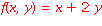 on the unit circle
occurs at (a,b). What is the value of a ?
a)  b)
b)  c)
c)  d)
d)  e)
e) 
f)  g)
g)  h)
h)  i) 1 j) 0
Solution: (a)
| > |
f := (x,y) -> x + 2*y: phi := (x,y) -> x^2 + y^2: |
| > |
eqn1 := diff(f(x,y),x) = lambda*diff(phi(x,y),x); |

| > |
eqn2 := diff(f(x,y),y) = lambda*diff(phi(x,y),y); |


| > |
solve( {eqn1,eqn2,eqn3}, {x,y,lambda}); |

| > |
levelCurve[1] := implicitplot( f(x,y)=f(sqrt(5)/5,2*sqrt(5)/5), x = -3/2..3/2,y=-3/2..3/2,color=pink,thickness=2): |
| > |
levelCurve[2] := implicitplot( x^2+y^2=1, x = -3/2..3/2,y=-3/2..3/2,color=plum,thickness=2): |
| > |
levelCurve[3] := contourplot(f(x,y), x = -3/2.. 3/2, y= -3/2..3/2, contours=10,color=COLOR(RGB,0.75,0.7,0.7)): |
| > |
display(seq(levelCurve[j],j=1..3)); |
![[Plot]](images/final-fl2002_68.gif)
8. If 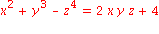 then calculate
  at
at  .
.
a) 1/8 b) 1/5 c) 1/4 d) 1/3 e) 1/2
f) 2/3 g) 3/4 h) 3/5 i) 4/5 j) 5/8
Solution: (a)
| > |
eqn1 := x^2+y^3-z(x,y)^4=2*x*y*z(x,y)+4; |

| > |
eqn2 := map(u -> diff(u,x),eqn1); |

| > |
eqn3 := diff(z(x,y),x) = solve(eqn2, diff(z(x,y),x) ); |

| > |
subs({x=3,y=2}, rhs(eqn3)); |


9. The vector  is tangent to the surface
 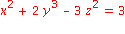 at the point (2,1,1). What is a ?
a) -5 b) -3 c) -3 d) -2 e) -1
f) 0 g) 1 h) 2 i) 3 j) 4
Solution: (c)
| > |
F := (x,y,z) -> x^2+2*y^3-3*z^2; |

| > |
grad(F(x,y,z),[x,y,z]); |
![VECTOR([2*x, 6*y^2, -6*z])](images/final-fl2002_80.gif)
| > |
v := subs({x=2,y=1,z=1}, " ); #Normal to surface |
![v := VECTOR([4, 6, -6])](images/final-fl2002_81.gif)
| > |
solve(dotprod(v,[a,1,-1])=0,a);
#Tangent vector is perpendicular to Normal vector |

10. Calculate 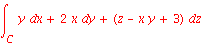 . where C is the oriented curve parameterized by
 ![r(t) = [t, t^2, t^3]](images/final-fl2002_84.gif) ,
,  .
.
a) 1/3 b) 2/3 c) 1 d) 4/3 e) 5/3
f) 2 g) 8/3 h) 3 i) 4 j) 14/3
Solution: (j)
![r := proc (t) options operator, arrow; [t, t^2, t^3] end proc](images/final-fl2002_86.gif)
| > |
Int( r(t)[2]*diff(r(t)[1],t)+ 2*r(t)[1]*diff(r(t)[2],t)+(r(t)[3]-r(t)[1]*r(t)[2]+3)*diff(r(t)[3],t),t=0..1); |


11. The vector field
![[Inserted Image]](images/final-fl2002_89.gif)
is the gradient field of some function f(x,y). Calculate f(1,2) - f(0,1).
a) 2 b) 4 c) 6 d) 8 e) 10
f) 12 g) 14 h) 16 i) 18 j) Cannot be calculated from given information.
Solution: (i)
| > |
F := vector([y^2+7,2*x*y+3*y^2]); |
![F := VECTOR([y^2+7, 2*x*y+3*y^2])](images/final-fl2002_90.gif)
| > |
curl(vector([y^2+7,2*x*y+3*y^2,0]),[x,y,z]); #F is conservative |
![VECTOR([0, 0, 0])](images/final-fl2002_91.gif)
| > |
eqn := u(x,y) = int(y^2+7,x) + g(y); |



| > |
diff(g(y),y) = solve(",diff(g(y),y)); |

| > |
eqn2 := subs(g(y)=y^3+C,eqn); |

| > |
subs( {x=1,y=2}, rhs(eqn2)) - subs({x=0,y=1}, rhs(eqn2)); |

12. Calculate 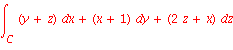 where C is the oriented curve parameterized by
 ![r(t) = [sqrt(t), sin(Pi*t^2/2), t*exp(t-1)]](images/final-fl2002_99.gif) ,
,  .
.
a) 0 b) 1 c) 2 d) 3 e) 4
f) 5 g) 6 h) 7 i) 8 j) 9
Solution: (e)
| > |
r := (t) -> [sqrt(t), sin(Pi/2*t^2), t*exp(t-1)]: |
![[0, 0, 0]](images/final-fl2002_101.gif)
![[1, 1, 1]](images/final-fl2002_102.gif)
| > |
F := vector([y+z,x+1,2*z+x]); |
![F := VECTOR([y+z, x+1, 2*z+x])](images/final-fl2002_103.gif)
| > |
curl(F,[x,y,z]); #F is conservative |
![VECTOR([0, 0, 0])](images/final-fl2002_104.gif)
| > |
eqn := u(x,y,z) = int(y+z,x) + g(y,z); |

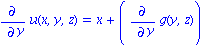

| > |
diff(g(y,z),y) = solve(",diff(g(y,z),y)); |

| > |
eqn2 := subs(g(y,z)=y+h(z),eqn); |

| > |
2*z+x = diff(rhs(eqn2),z); |
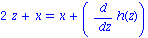
| > |
diff(h(z),z) = solve( " , diff(h(z),z)); |

| > |
eqn3 := subs(h(z)=z^2 + C, eqn2); |

| > |
evalm( grad(rhs(eqn3),[x,y,z]) - F ); #Check |
![VECTOR([0, 0, 0])](images/final-fl2002_113.gif)
| > |
subs( {x=1,y=1,z=1}, rhs(eqn3)) - subs({x=0,y=0,z=0}, rhs(eqn3)); |

13. Consider a vector field
![[Inserted Image]](images/final-fl2002_115.gif)
in the region G that is shown. (G is a subset of the plane z = 0 in xyz-space.) Suppose that F is twice-continuously differentiable.
Consider the following properties that F may have.
I ) F is path-independent.
II ) F has a potential function
III ) curl( F ) = 0
IV ) ![[Inserted Image]](images/final-fl2002_116.gif)
Write "A implies B" as "A => B".
At least one of the implications stated in the answers may be incorrect. Choose any incorrect statement
as your answer.
a) I => II b) II => III c) III => IV d) IV => I e) I => III
f) II => I g) I => IV h) II => IV i) IV => III j) IV => II
Solution: (c)
Properties I, II, and IV are equivalent. They all imply property III. However, G is not simply connected so
property III does not imply any of the others.
14. Calculate 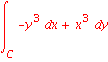 where C is the unit circle traversed counter-clockwise.
a)  b)
b)  c)
c)  d)
d)  e)
e) 
f)  g)
g)  h)
h)  i)
i)  j)
j) 
Solution: (i)
| > |
r := t -> [cos(t),sin(t)]: |
| > |
Int( -r(t)[2]^3*diff(r(t)[1],t) + r(t)[1]^3*diff(r(t)[2],t),t=0..2*Pi); |
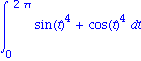

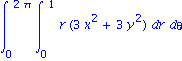
More easily by Green's Theorem:
| > |
Int(Int(r*(diff(x^3,x)-diff(-y^3,y)),r=0..1),theta=0..2*Pi); |
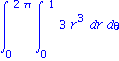

15. Let G be a solid region in space. Suppose that the boundary S of G is an orientable closed surface with outward unit normal n. Vector calculus tells us that
![[Inserted Image]](images/final-fl2002_133.gif)
for some function f. If
![[Inserted Image]](images/final-fl2002_134.gif)
then what is f(1,2,3) ?
a) 0 b) 1 c) 2 d) 3 e) 4
f) 5 g) 6 h) 7 i) 8 j) 9
Solution: (g)
| > |
diverge([x*y,2*y*z,x^2+x^2*y^3-y*z],[x,y,z]); |


16. If 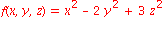 then calculate div(grad(f(x,y,z)).
a) 1 b) 2 c) 3 d) 4 e) 5
f) 8 g) 12 h) 15 i) 16 j) 20
Solution: (d)
| > |
f := (x,y,z) -> x^2 - 2*y^2 + 3*z^2; |

| > |
grad(f(x,y,z),[x,y,z]); |
![VECTOR([2*x, -4*y, 6*z])](images/final-fl2002_139.gif)

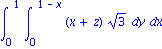
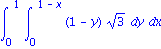
17. Calculate the surface integral of  over that part of the plane
that lies in the first octant.
a) 0 b) 1 c)  d)
d)  e)
e) 
f)  g)
g)  h)
h)  i)
i)  j)
j) 
Solution: (d)
| > |
vectorLength := v -> sqrt(sum(v[i]^2,i=1..vectdim(v))); |
![vectorLength := proc (v) options operator, arrow; sqrt(sum(v[i]^2, i = 1 .. vectdim(v))) end proc](images/final-fl2002_151.gif)
| > |
r := (x,y) -> vector([x,y,1-(x+y)]); #surface parameterization |
![r := proc (x, y) options operator, arrow; vector([x, y, 1-x-y]) end proc](images/final-fl2002_152.gif)
| > |
rx := map(z->diff(z,x),r(x,y)); |
![rx := VECTOR([1, 0, -1])](images/final-fl2002_153.gif)
| > |
ry := map(z->diff(z,y),r(x,y)); |
![ry := VECTOR([0, 1, -1])](images/final-fl2002_154.gif)
![VECTOR([1, 1, 1])](images/final-fl2002_155.gif)
| > |
surfaceAreaFactor := vectorLength("); |


| > |
Int(Int(f(x,y,z)*surfaceAreaFactor,y=0..1-x),x=0..1); |

18. Let S be the surface formed by the four triangular sides of the pyramid whose vertex is at (0,0,1) and whose base is the square with vertices (1,1,0), (-1,1,0), (-1,-1,0), and (1,-1,0).
If n denotes the outward pointing unit normal on S then calculate
a) 0 b) 2 c) 4 d) 6 e) 8
f) 10 g) 12 h) 14 i) 16 j) 20
Solution: (c)
Using Stokes's Theorem the required surface integral can be calculated by the line integral

integrated counterclockwise over the boundary of the square in the xy plane. Since z = dz = 0 on all four sides and dy = 0 on the two sides parallel to the x-axis we have
| > |
int(1,y=-1..1)+int(-1,y=1..-1); |

19.
![[Inserted Image]](images/final-fl2002_163.gif)
a)  b)
b)  c)
c)  d)
d)  e)
e) 
f)  g)
g)  h)
h)  i)
i)  j)
j) 
Solution: (h)
Using the Divergence Theorem
![F := VECTOR([x, 0, -z])](images/final-fl2002_174.gif)
| > |
surface_eqn := z + x^2 + y^2 = 2; |

| > |
N := grad(lhs(surface_eqn),vector([x,y,z])); |
![N := VECTOR([2*x, 2*y, 1])](images/final-fl2002_176.gif)

| > |
Integrand := subs(z=2-x^2-y^2, " ); |

| > |
Integrand := subs({x=r*cos(theta),y=r*sin(theta)},Integrand); |

| > |
int(int(r*Integrand,r=0..1), theta = 0 .. 2*Pi); |

Alternative calculation using the Divergence Theorem
| > |
parab := plot3d(2-x^2-y^2, y = -sqrt(1-x^2)..sqrt(1-x^2),x=-1..1,color=aquamarine): |
| > |
disk := plot3d([r*cos(theta),r*sin(theta),1],r=0..1,theta=0..2*Pi,color=plum): |
![[Plot]](images/final-fl2002_181.gif)

Therefore the sum of the required integral (integrated over the aquamarine paraboloid) and the flux integral through the bottom plum disk is equal to 0.
On the plum disk the unit outward normal is - k and
| > |
dotprod(F,vector([0,0,-1])); |

But on the plum disk z = 1. Therefore:
| > |
required_integral = -int(int(1*r,r=0..1),theta=0..2*Pi); |

20.
![[Inserted Image]](images/final-fl2002_185.gif)
a)  b)
b)  c)
c)  d)
d)  e)
e) 
f)  g)
g)  h)
h)  i)
i)  j)
j) 
Solution: (i)
Using the Divergence Theorem
| > |
F := vector([x,0,z^2]); |
![F := VECTOR([x, 0, z^2])](images/final-fl2002_196.gif)

| > |
int(int(r*int(diverge(F,[x,y,z]),z=0..1),r=0..1),theta=0..2*Pi); |
